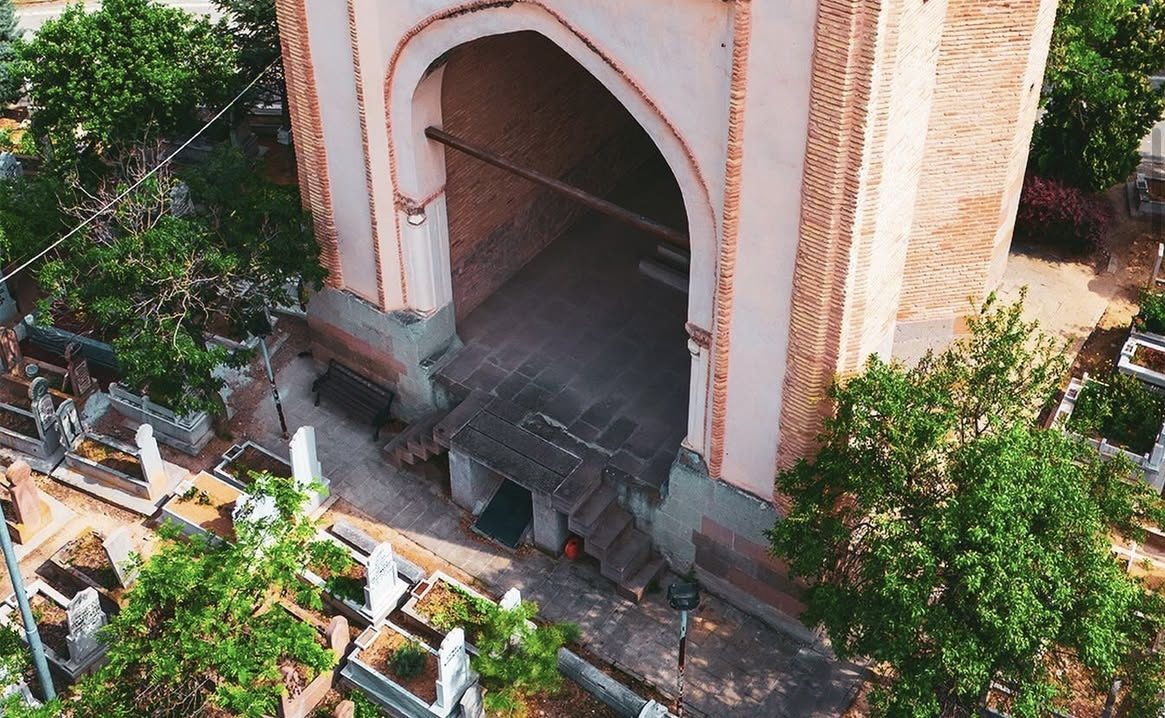
Historic documents state that Gömeç Hatun was the wife of Sultan Rukn al-Din Qilich Arslan IV, who was assassinated by the Mongols in 1266. Although it is unknown how long Gömeç Hatun lived after her husband's death, it is likely that her tomb was built during the last quarter of the thirteenth century.
The Tomb of Gömeç Hatun is located in Musalla Cemetery in the Kalenderhane neighbourhood of Konya. The two-storey monument has a rectangular plan oriented north–south. It features an iwan rising from a high socle. The entrance façade, with its iwan arch, is wider and taller than the main body of the structure, giving the monument a monumental character. Two flights of stairs rise along the socle and meet at the centre of the iwan. The rectangular hall is covered with a pointed barrel vault, and a mihrab niche is set into the south wall.
Beneath the stair landing is a lintelled doorway leading to the crypt below. The rectangular crypt is covered with a trough vault and receives daylight through five slit windows in the east, west, and south walls.
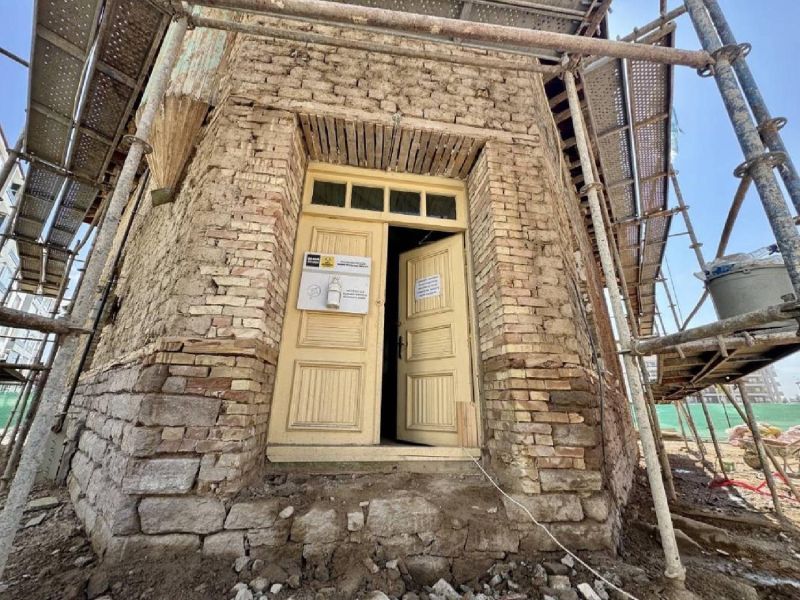
A spur-shaped triangular buttress is located at the centre of each of the east and west walls. The structure was built of brick and stone. The lower exterior is faced with dressed stone, while the upper sections are constructed of brick.
The tile decoration on the iwan façade is particularly impressive. The surviving remains indicate that the face, intrados, and keystone of the arch, as well as the colonnette capitals and the spandrels, were decorated with turquoise and eggplant-purple mosaic tiles arranged in geometric compositions. Although the wide band framing the iwan arch was most likely originally decorated with mosaic tilework, it is now completely covered with plaster. On the exterior, the tops of the remaining three walls are crowned with crenellations, enhancing the monument's decorative appearance.