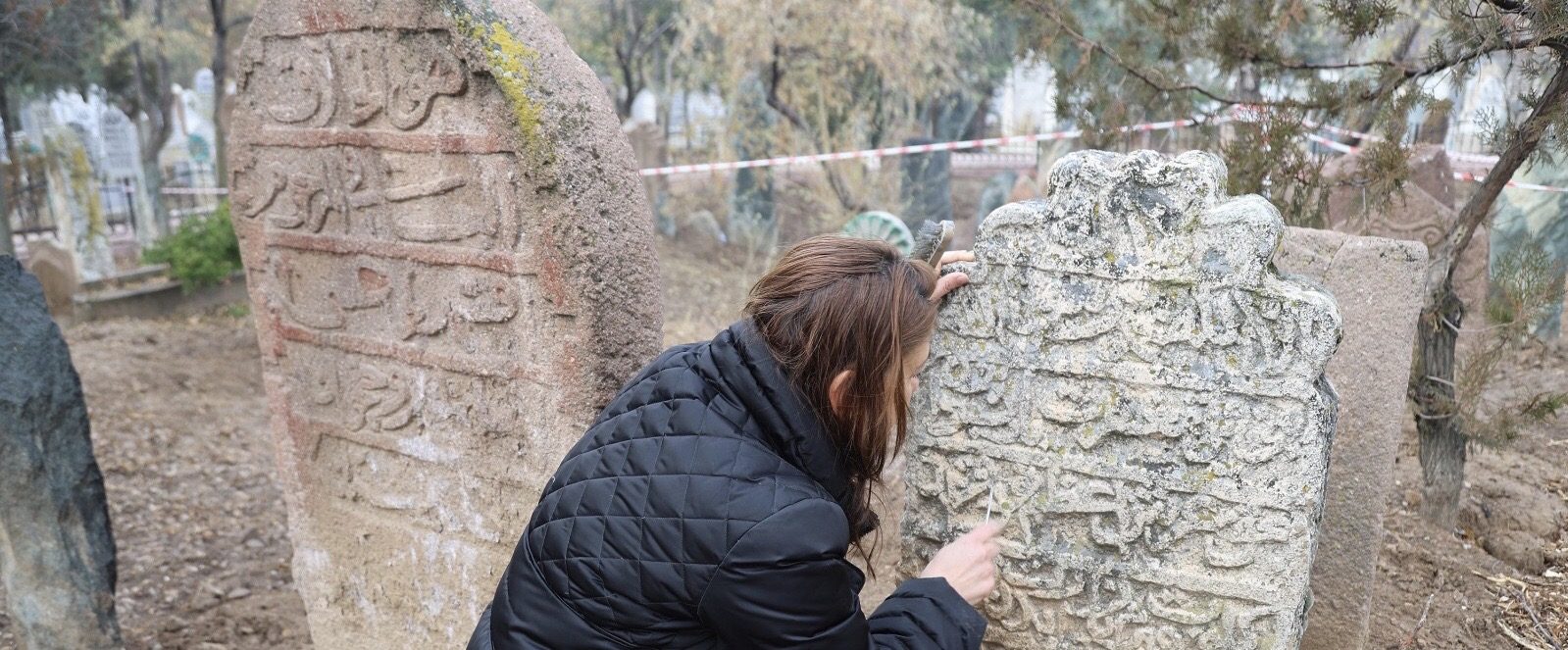
Konya Metropolitan Municipality is undertaking the restoration of tombstones in the historical area of Musalla Cemetery, a site rich in tombs and hospices dating back to the Anatolian Seljuk period.
Konya Metropolitan Municipality Mayor Uğur İbrahim Altay stated that Konya, the former capital of the Anatolian Seljuk Empire, is an ancient city with thousands of years of history and that they are working to fulfill their responsibilities to pass on their values to future generations.
Mayor Altay stated, 'There are numerous martyrs' graves and hospices from the Anatolian Seljuk period in a particular area within the cemetery. Moreover, the tomb and the garden known as 'Sirac Garden' of Qadi Siraj al-Din al-Urmawi, one of the greatest logicians of the Anatolian Seljuk period and the Islamic world, are also located here. In addition, there are tombs of Evhaüddin Kirmani, Sheikh Halili, Sheikh Shujaeddin and others from the Seljuk and Ottoman periods, along with their tombstones. This area within the Musalla Cemetery is one of the most important Anatolian Seljuk cemeteries after Ahlat.'
The Musalla Cemetery, which dates back to the 13th century, was registered and placed under protection on November 25, 1988, with decision number 339, by the Konya Cultural and Natural Assets Protection Board. The oldest and most special part of the cemetery, situated on 141 islands, was separately registered as a historical site on December 19, 2014, with decision number 2481. In order to preserve the historical and cultural heritage of the region, Konya Metropolitan Municipality closed Musalla Cemetery to new interments in 2021.