Masters of the sea
Phoenicians were one of the most effective societies in 1000 B.C. But at the same time they are still one of the least understandable communities by the modern historians. Actually, there wasn’t a kingdom called “Phoenicia”. The civilization that we today call as Phoenicians were a series of cities along the coastal area in Lebanon, Syria and North Israel and this is a matter of fact that we really know little about them.
It is thought that they were called as Phoenicians by the Greek as a tribute to the colour purple. Although the origin is ambiguous, the word “phoenix” is known to refer to the colour red-tinged purple, and in time it is believed to evolve to another word that means a kind of purple fabric that is special to Phoenicians. Another popular assumption is that the word is linked to the legendary king Phoinix who is believed to be started the use of purple paint.
Invaluable Purple
In ancient times, the production of fabric was the most troublesome craft. However, the cultural, social and economic importance was indispensable. The clothes were not only preserving people from outside conditions but also were showing their social status. The fabric was turned into carpets and rugs in order to be used as a vehicle to tell a story and it was also so priceless that it was started to be used as a currency.
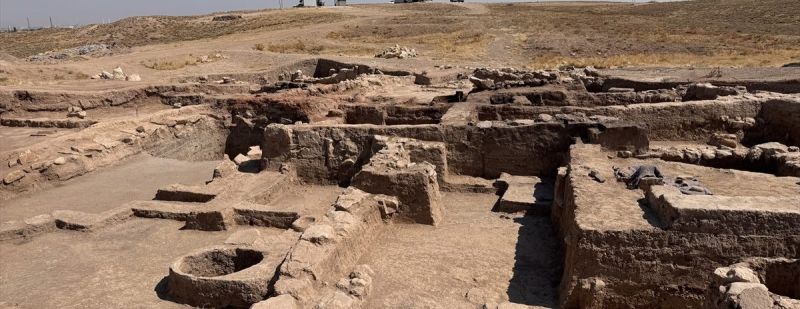
As only a few pieces of fabric are able to reach today we know very little about how Phoenicians produced it and how it looked in real. Although there is very little information about the fabric, the production and usage of purple paint is described in details in ancient resources. The discovery of some workplaces in which murexes were collected, processed and used to obtain purple paint along the coastal area in Arvad, Beirut, Sayda, Sarepta, Sur and Levant shows that how this sector was important and common for Phoenicians.
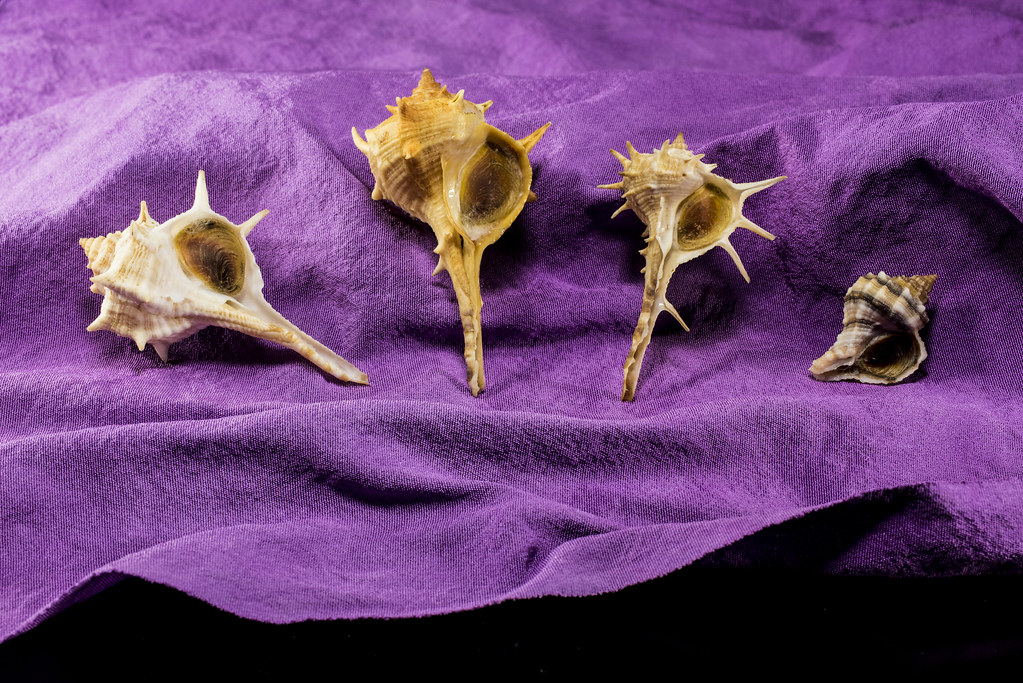
In the 1st century A.D., a Roman Naturalist the Great Plinius wrote a book called Historia Naturalis. In his work, he gives the most detailed information about how the paint was produced. According to this book, the basic raw material of this paint is an opaque liquid which is obtained from mucous gland of Murex trunculus and Murex brandaris. Murex trunculus was used to obtain blue-purple paint also called kingdom blue. Murex brandaris was used to obtain paint called Tyrian purple.
Both colours were pretty permanent. The fabric painted with these colours weren’t fading easily and it was a very rare speciality for the paints then. However, there was a problem about this paint. During its production, there was a terrible smell. This interesting topic was also mentioned in Plinius’s work.
From a single murex only a few drops of mucus were obtained. So, in order to do business on Tyrian purple, it was needed to collect a huge number of murexes. Archaeologists estimated that approximately 1, 5 grams of paint was obtained from medium size 12000 molluscs. And such a small amount of paint was able to paint only a small part of a cloth. As a result, to paint a small part of cloth, a huge amount of murexes were required. To paint a complete cloth was equal to a fortune.
Consequently, Tyrian purple was much more valuable than the same amount of gold and silver then and the fabric in purple was sold to huge prices. According to the historian Theopompus who lived in the 4th century B.C., the men in Colophon wore such purple clothes and walked around the city although these kinds of clothes were very difficult to reach even for the kings and after that, these clothes were sold for silver
Indeed, the purple paint was such in a demand that some cunning merchants produced a lot of different tones with a lower quality in order to meet the increasing demand. For this reason, when archaeologists find any parts of purple cloth and jugs, they make a series of chemical analysis before announcing them as kingdom blue or Tyrian purple.