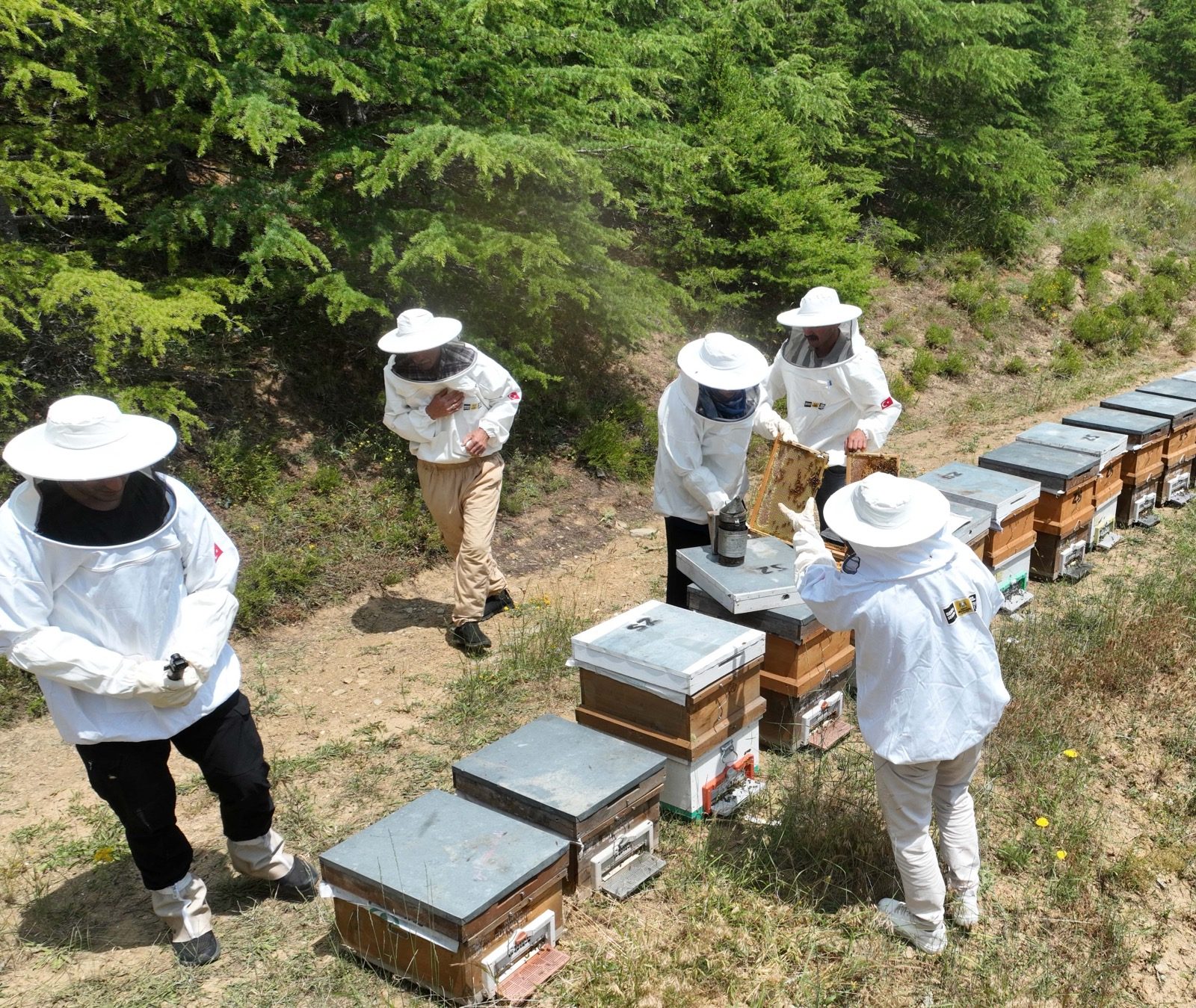
Equipment, training and infrastructure support provided to local beekeepers is helping increase production capacity across the province and promote more informed beekeeping practices.
As part of the municipality’s equipment grant programs, producers have received fully automatic honey extractors, honey settling tanks, pollen-trap beehives, extraction tents and solar panels. These resources have significantly increased the production capacity of small-scale beekeeping operations and encouraged more people to take up the profession.
Solar panel support has been particularly beneficial for migratory beekeepers by meeting their energy needs, while modern extraction equipment has reduced labor requirements and enabled waste-free production by ensuring that no honey is left in the honeycomb.
Although Konya is primarily known for grain production, beekeeping has become a strategic agricultural sector in recent years. The number of registered beekeeping operations has risen from 1,012 to more than 1,700 over the past decade, while the number of beehives has increased from 93,000 to approximately 140,000.
Konya Metropolitan Municipality Mayor Uğur İbrahim Altay said the municipality provides producers with support and training programs across a wide range of fields, from field and garden crops to livestock farming, beekeeping and modern irrigation techniques.
Onur Sapmaz, a 27-year-old graduate of a beekeeping program and migratory beekeeper living in the Fırınlı neighborhood of Doğanhisar district, highlighted the significant contribution of modern technology to production.
Sapmaz said they had previously operated between 300 and 400 hives but had expanded their operation to 1,000 hives thanks to the technological support provided by the Metropolitan Municipality.
“We received 20 pollen-trap beehives, extraction tents, a centrifugal honey extractor and honey settling equipment from our municipality. In the past, the old hand-cranked machines passed down from our grandfathers were extremely exhausting to use. Now we have fully automatic, technologically advanced machines with Turkish-language settings. They start spinning at the press of a button.
“We begin the season in spring with fruit blossoms in Akşehir, then harvest thyme and milkvetch honey in the countryside around Yunak. After that, we travel to Sakarya for chestnut honey and to Bodrum in Muğla for pine honey. As people in our neighborhood saw how much we had grown, the number of beekeeping households increased from just three or four to 20,” he said.
Emphasizing that the municipality also provides ongoing technical expertise in the field, Sapmaz said:
“Our Metropolitan Municipality also provides technical support. Whenever there is a disease outbreak, a need for an inspection or a case of poisoning, they immediately send specialists to us. They share all kinds of technical information with us, and we provide them with our analyses. We are grateful for their close attention and support. As long as Mayor Uğur İbrahim Altay continues to support us, we will keep growing.”
Harun Sapmaz, head of the Fırınlı neighborhood in Doğanhisar, said the community was continuing a family tradition of beekeeping.
“Back in 2016, our neighborhood had around 2,000 to 3,000 beehives. With the Metropolitan Municipality’s support in the form of modern machinery, hives and beekeeping assistance, that number has risen to around 7,000.
“When we used traditional machines for honey extraction, a considerable amount of honey remained in the combs and went to waste. We also had to discard damaged combs. Thanks to the new, technologically advanced extraction machines, no honey is left in the combs. This directly contributes to our local economy and increases our earnings,” he said.