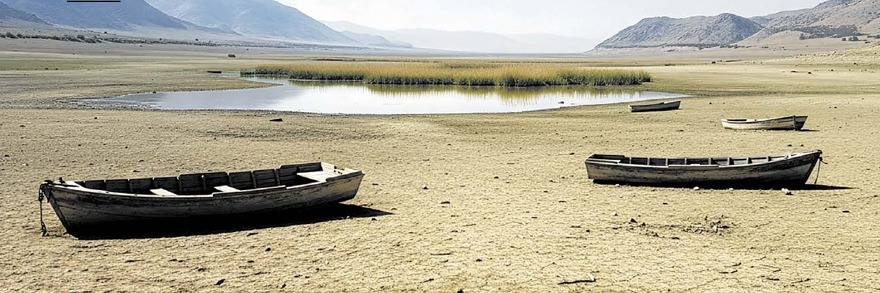
Special action plans are being prepared by the State Hydraulic Works (DSİ) against drought risk for 8 critical lakes, including Beyşehir, Akşehir, and Tuz Lake.
8 LAKES INCLUDED IN THE ACTION PLAN DSİ
General Director Mehmet Akif Balta addressed the work carried out by the institution on this issue. He stated that “the State Hydraulic Works (DSİ) has prepared special Action Plans against drought risk for 8 critical lakes, including Bafa Lake, and that the protection of water resources is targeted through modern irrigation systems, artificial intelligence–supported automation, and energy efficient projects.”
AKŞEHİR–BEYŞEHİR AND TUZ LAKE
Emphasizing that water level declines and ecosystem changes in lakes are being closely monitored, DSİ General Director Mehmet Akif Balta said that “The most important step against this situation was taken at the 3rd Meeting of the National Water Council, held on December 24, 2024, under the auspices of our Minister; it was decided to prepare action plans for lakes under drought risk. In line with this decision, action plans are being prepared primarily for 8 lakes (Eğirdir, Akşehir–Eber, Manyas, İznik, Burdur, Bafa, Beyşehir, and Tuz Lake). Among these, the Eğirdir Lake Action Plan was announced to the public with the participation of our Minister.
WORK CONTINUES AT FULL SPEED
Stating that DSİ has carried out significant work on water efficiency, General Director Balta said that “As DSİ, we have identified two main categories of measures aimed at reducing the adverse impacts of climate change: structural measures (such as facility and infrastructure construction) and non structural measures (such as management and training). Within the scope of our structural measures, we continue water and irrigation investments without slowing down. Over the last 23 years, a total of 10,984 facilities have been commissioned. In the next 3-year period, an additional 1,162 water and irrigation investments are planned to be completed. We have carried out a comprehensive modernization of our irrigation systems. We increased the share of pressurized-piped systems from 6 percent to 38 percent. The target for 2028 is 45 percent. In addition, within the scope of converting open irrigation systems to closed systems, planning, project, and construction works are ongoing across an area of 1.3 million hectares. Alongside this modernization, over the last 16 years, we have met the needs of 174 irrigation facilities through maintenance and repair projects, increasing transmission efficiency. Thanks to these systems, especially with prepaid metering systems, irrigation efficiency has been increased to 84 percent, and water consumption per hectare has been reduced to 5,092 cubic meters.”