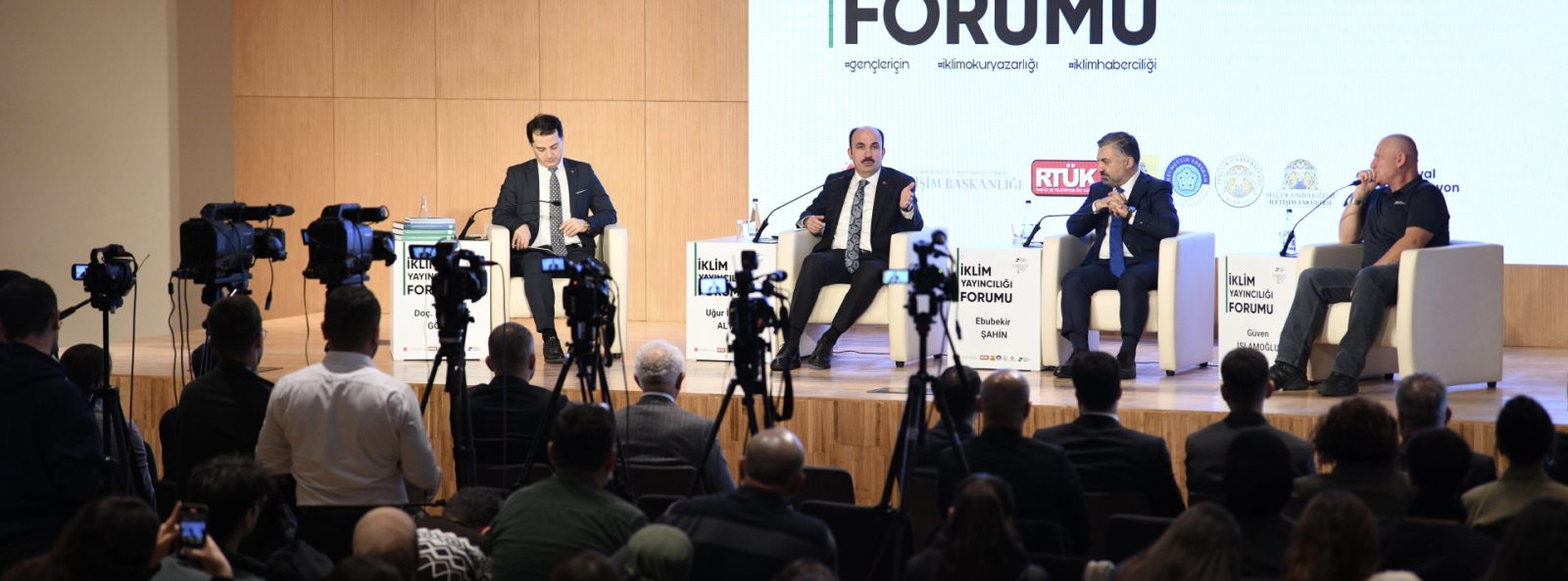
The 3rd Climate Broadcasting Forum was held as part of the 1.5 Degrees - Climate Literacy and Journalism for Youth program, organized in collaboration with the Presidential Directorate of Communications, the Radio and Television Supreme Council (RTÜK), Konya Metropolitan Municipality, Necmettin Erbakan University, and Selçuk University.
The forum, held at the Metropolitan Municipality’s Taş Bina Culture and Arts venue under the leadership of the Konya Metropolitan Municipality Social Innovation Agency, was moderated by Assoc. Prof. Dr. Oğuz Göksu, Head of the Press and Broadcasting Department of the Presidential Directorate of Communications. Assoc. Prof. Dr. Göksu expressed his gratitude to the Konya Metropolitan Municipality for its contributions to organizing the event.
Mayor Altay stated, “There are two countries that have the greatest impact on climate change: China and the United States. Unfortunately, they are not making significant efforts to change or transform themselves. This is not a regional issue; the entire world is caught in a spiral. The so-called butterfly effect manifests most naturally in climate change. Whatever you do, people in other parts of the world inevitably feel the consequences. Therefore, on one hand, we are striving to emphasize how crucial it is for municipalities and local administrations to have a seat at the table and take a stance as part of our international responsibilities. On the other hand, we are working hard to figure out what we can do to make the people living in our city more resilient to disasters.”
Mayor Altay emphasized, “Rest assured that, as Konya Metropolitan Municipality, our sensitivity on this issue is at the highest level. We strive not to engage in social media-oriented or popularized municipal practices because we will continue to live in this city you have entrusted to us. When I began my role as mayor in 2009, rainwater drainage was not even on our agenda. Yet today, it is one of KOSKİ’s (Konya Water and Sewerage Administration) top priorities to protect the city from rainwater and floods. Why? Because precipitation patterns have changed. With these changes, we were compelled to discuss what measures we could take to utilize excessive rainfall. The water comes and goes, but if we can’t retain it, we can’t use it. We realized the need to protect lakes, to preserve life, to increase green spaces, and to expand the use of natural gas. We are making great efforts to enhance these areas. God willing, Konya will continue to lead and set an example in this regard.”
The program was attended by students from Selçuk University's Faculty of Communication and Necmettin Erbakan University's Department of Radio, Cinema, and Television.