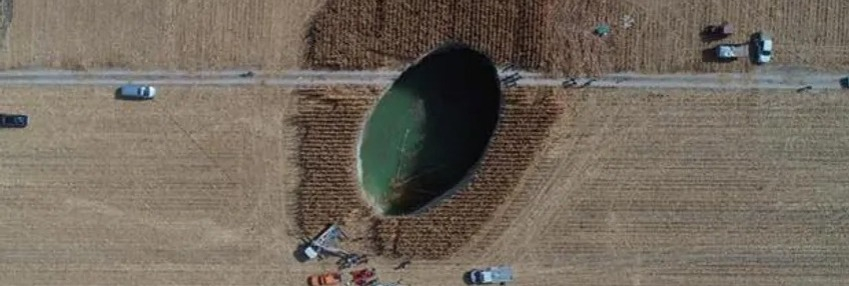
In Konya, as underground waters recede and the soil erodes, the number of sinkholes has reached 2,500, with some of the newly formed ones exhibiting volcanic gas emissions.
Associate Professor Dr. Arif Delikan, a faculty member of the Geological Engineering Department at Konya Technical University, stated that this year, a more dynamic period is being experienced in sinkholes. He mentioned, "In the Ekmekçi Plateau, a sinkhole that measured 30 meters in diameter in February was only half a meter deep. Extraordinary gas emissions were observed here for 2 hours a month ago, followed by a collapse of 1.5 meters. Gas emission continues here and increases at certain periods."
Sinkholes, predominantly occurring in the Karapınar district of the Konya Plain, have started to appear in recent years in neighboring regions such as Ereğli, Halkapınar, Emirgazi, Çumra, as well as in Cihanbeyli, Kulu, Yunak, Çeltik, and Altınekin districts. Observations indicate that some of the newly formed sinkholes in these areas exhibit volcanic gas emissions.
In the research conducted in the Karapınar region as part of the Sinkhole Detection Project led by the Disaster and Emergency Management Authority (AFAD), Associate Professor Dr. Arif Delikan from the Geological Engineering Department of Konya Technical University, who is involved in the investigation, stated that the number of sinkholes is rapidly increasing. He said, "The number of sinkholes in this area is greater than all the known sinkholes in Turkey. In 2023, at least 7 sinkholes formed in the Ekmekçi Plateau and Seyit Hacı Plateau. One week ago, we updated the dimensions of a sinkhole with a depth of 2 meters and a diameter of 15 meters to 30 meters by 15 meters."